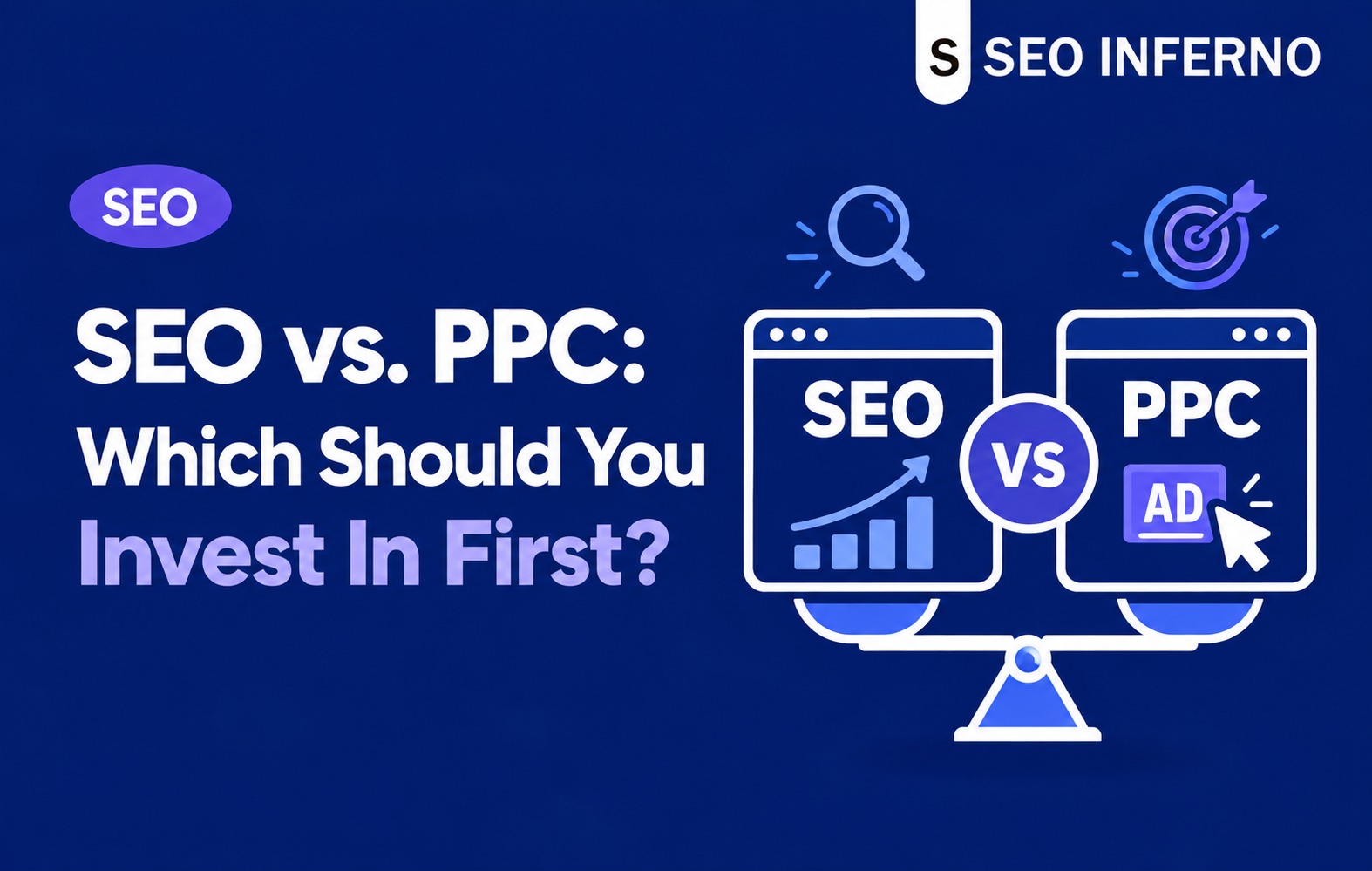
At some point, every business with a small marketing budget will ask the question: should the first dollar be spent on SEO or PPC? While both channels have the same goal of getting a business found in search results, they operate on different timelines, different cost structures, and different methods. The first wrong choice, or attempting to make both without a plan, can result in wasted expenditure and slower growth. If you know what each channel does, it becomes easy to make the decision.
SEO and PPC Are Not The Same
SEO is about getting organic rankings by optimizing your site’s health, creating quality content, and building authoritative backlinks. It’s not a paid-to-click service, but it does require time, typically 3-6 months before it starts to make a difference in rankings, and even longer in competitive industries.
Pay per click (PPC) advertising, on the other hand, purchases visibility on the spot. A business can be at the top of search results in hours by bidding on the correct keywords and running a campaign. The downside is that, once the budget ends, visibility goes out the window. PPC is rental, meanwhile, SEO is an equity that grows over time.
There’s no right or wrong answer, they address different issues, and the best place to begin depends on the timeline, budget and objectives of the business.
When Does PPC Make Sense First?
In some cases, PPC is the more appropriate option to begin with:
New businesses without any online history: A brand new website has no domain authority, no backlink profile, and no ranking history. It could take months to rank organically for competitive terms. PPC does that immediately, and it brings traffic and leads to your website while SEO takes effect in the background.
Time-sensitive promotions: You don’t have months to produce organic rankings for a seasonal sale, a product launch or a fixed date event. PPC provides instant visibility that is directly linked to a deadline.
Evaluating keyword and messaging effectiveness: PPC campaigns generate quick data to determine which keywords are converting and which ad messaging is working. That data can feed directly into the SEO content strategy later, so that the two channels complement each other, and not compete.
Competitive, high dollar keywords: Even with good SEO, it can take a long time in certain industries (legal services, insurance, home services) to rank organically for the most valuable keywords. In the interim, PPC can be used to compete for that traffic.
When SEO Should Come First
SEO tends to be the smarter first investment when:
The business has a longer runway: SEO is most beneficial to companies with a planning horizon of 12 months or more. Content and backlinks created today continue to drive traffic long after the initial investment.
Funds are tight and must be stretched: PPC costs are directly proportional to the number of clicks, when you stop spending money, you stop getting clicks. SEO takes a certain amount of investment in strategy and content, but once it’s done, the traffic doesn’t go away.
The objective is brand authority over the long-term: Organic rankings are more believable than paid ads. For some users, ads are a thing of the past and organic results are more trusted, especially for research-driven purchases such as B2B services or high-dollar items.
There are technical problems with the site: A slow, unstructured website that is hard to crawl for search engines cannot be fixed with PPC. In these situations, it is advisable to begin with a Technical SEO Audit Services engagement, as the audit will provide an overview of the site’s speed, crawlability, indexability, mobile-friendliness, and URL structure, identifying the necessary fixes to enhance both the landing page experience for PPC traffic and its organic performance. It doesn’t matter how well the campaign is built, if the site is broken or slow, then paid traffic will be wasted.
Why the Smartest Strategy Often Combines Both
This is an either/or statement, which ignores the fact that the two channels complement each other in practice. PPC data shows you what keywords and offers are converting and which topics to invest in SEO. Content that is optimized for SEO can also help boost the Quality Score of ads in ad platforms, which can help reduce PPC costs. When you run both at the same time, a business will appear twice on the same results page, meaning that it will get more clicks and more brand visibility.
That’s why many businesses that begin at one end eventually seek expertise for the other, and why agencies are more likely to provide integrated services than separate departments. A SEO Services Company that also handles paid campaigns, or works closely with one, can coordinate messaging, targeting and budget across both channels rather than having them operate as separate campaigns.
How AI Has Transformed The Calculation
With the emergence of AI-powered search, such as answer engines, AI Overviews, and chatbot-like search assistants, there’s a new factor to consider in this choice. Content structure is becoming a critical factor for achieving organic visibility, as it enables AI systems to interpret and summarize the content.The structure of content is becoming a key factor in achieving organic visibility, as it allows AI systems to interpret and summarize the content. This has led to the rise of AI SEO services as a major factor in the SEO investment discussion, as ranking in the traditional sense doesn’t mean a business is being surfaced or cited by AI-generated answers.
Meanwhile, PPC platforms have added more automated bidding and AI-powered audience targeting, impacting the speed and effectiveness of paid campaigns. The decision between SEO and PPC is not merely about the cost and time involved, but also how AI is transforming both channels. When considering SEO vs PPC today, companies must consider not only the cost and time of each channel, but how AI is reshaping both.
For Agencies Managing Multiple Clients
Unlike individual businesses, agencies that manage multiple client accounts with SEO and paid marketing strategies are confronted with a scaling challenge. Creating and maintaining PPC campaigns for each client demands specific expertise in bid management, ad copywriting, and platform optimization, which can be difficult to maintain. That’s where white label PPC management makes sense: An agency can provide paid search services under its own name, while a specialized partner takes care of the campaign execution. It allows agencies to provide a comprehensive service offering, including SEO, content and paid media, without having to establish their own paid media team.
The Decision-Making Process For Your Business
The answer to which channel to go first is not one size fits all, but depends on runway, budget, technical readiness, and the speed of results. A helpful perspective to consider:
- Need traffic now? Start with PPC.
- Building for the next few years? Start with SEO.
- Does the site have technical problems? Do an audit first, before investing in either.
- Have a budget for both? Run them side by side and allow them to teach each other
The fastest growing businesses don’t just choose one channel and abandon the other forever. They begin with where their immediate needs are taking them, and then develop a plan that integrates both SEO and PPC, one that gives them immediate visibility and the other that gives them long-term equity that continues to pay off well after the ad budget is exhausted.