SEO is evolving at a rapid pace, and AI is at the forefront of this evolution, transforming the way search engines assess content, the way marketers approach strategy, and the way agencies produce results for their clients.
However, there is one question that always comes to mind: What exactly are AI SEO services, and how are they truly different from conventional SEO? This guide explains it all — from local SEO services to SEO link building services — and you’ll know where the benefit is.
The Fundamentals Of Traditional SEO
Traditional SEO is based on manual, rule-based methods that have remained largely unchanged over the past 20 years:
- Manual keyword research involves using tools such as Google Keyword Planner or SEMrush to identify keywords.
- On page optimization: Title tags, Meta descriptions, Headers, Body content
- Content creation based on keyword lists
- Manual link building outreach
- Regular technical audits for crawl issues and site health
- Monthly reporting of rankings and traffic
Traditional SEO is effective — it has created many successful online businesses over the years. However, it has three fundamental limitations that AI is addressing: it’s slow, it’s manual, and it can’t handle the amount of data the search environment requires today.
What Are AI SEO Services?
AI SEO services leverage artificial intelligence, machine learning, and natural language processing (NLP) to analyze vast amounts of data in real-time, uncovering patterns that human analysts might miss and providing insights and optimizations that are faster and more comprehensive than what can be achieved manually.
It’s not one tool, it’s an ecosystem used throughout all aspects of SEO:
- Semantic keyword research to identify relationships between topics, not just keywords
- Content optimization using NLP technology that analyzes the top-ranking pages for depth, structure, and entity coverage
- Predictive analytics that anticipate ranking opportunities before they are competitive
- Automated technical monitoring that identifies issues as they happen
- AI-driven prospecting and outreach for better SEO link building services
- Intelligent local SEO tools that handle Google Business Profiles and citation consistency
The result is an approach that’s more comprehensive, data-driven, and adaptable to algorithm changes than any manual process can be.
Key Differences: AI SEO Services vs Traditional SEO
Speed and Scale
A good analyst may analyze 50 competitor pages in a day. AI processes tens of thousands of data points in minutes, allowing agencies to get campaigns off the ground quicker and act before rankings are affected by algorithm updates.
The Depth Data Analysis
A typical SEO tool will tell you that a keyword receives 5,000 monthly searches and has a difficulty score of 42. An AI system lets you know why competitors are ranking — common content structures, missing entities, specific backlink patterns — and where your fastest route to page one truly lies. This strategic depth is automatically and continuously generated, and is not possible with manual analysis.
Content Optimization
Traditional optimization is all about keyword density and length. NLP can be used with AI tools such as Surfer SEO, Clearscope, and MarketMuse to examine the semantic structure of the top-ranking pages and identify the topics, entities, and questions that your page is missing. The emphasis is on topical authority and semantic completeness, the signals that modern algorithms value.
Predictive Capabilities
Traditional SEO is retrospective — you optimize based on what’s working today. By leveraging historical ranking information, AI models can identify emerging keyword trends before they reach their peak and predict the impact of algorithm changes on different types of content, enabling you to optimize your content for tomorrow’s search landscape instead of yesterday’s.
How AI Transforms Local SEO Services
Local search relies on balancing Google Business Profile signals, citation consistency, review sentiment, hyperlocal content relevance, and proximity data, which is incredibly difficult to maintain across multiple locations. AI handles this by:
- Automating Google Business Profile updates, post schedules, and Q&A responses.
- Scanning hundreds of directories at scale to catch and correct NAP (name, address, phone) inconsistencies
- Real-time sentiment analysis of reviews to identify reputation threats before they get out of hand
- Creating hyperlocal content briefs from location-specific search gaps
- Monitoring Google Map Pack ranking in real time, so that same-day responses can be made
This is not only an efficiency boost, but the only way to provide the accuracy that today’s
competitive local markets require for multi-location businesses and agencies.
How AI Elevates SEO Link Building Services
The relationship, editorial judgment, and personalized communication that have always been the backbone of link building are the most difficult aspects of SEO to automate. AI is not replacing those human factors, it’s enhancing what link builders can do. Modern AI-powered link building:
- At scale, prospects are discovered – thousands of relevant, authoritative opportunities are identified through competitor and content gap analysis.
- Ranks prospects based on domain authority, organic traffic, spam likelihood, and topical relevance
- Creates customized outreach that mentions specific site content, resulting in 2-3 times more responses than generic outreach
- Automates follow-up sequences without manual intervention.
- Continuously monitors health to ensure links remain live, indexed and passing equity
The outcome: more links, faster, and with a higher average domain authority than manual campaigns can maintain.
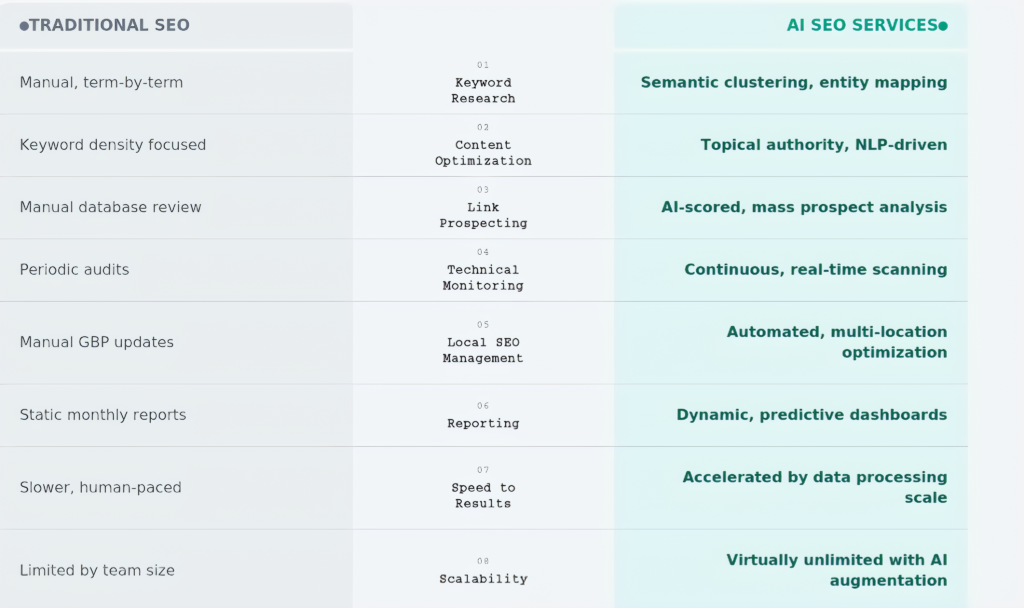
Traditional SEO vs AI SEO: Side By Side Comparison
FAQ’s
1. Can AI SEO services be applied to small businesses or just big enterprises?
Both. While AI is essential for enterprises in managing complex, multi-market campaigns, small businesses can also leverage it to their advantage, especially in local SEO, where AI can optimize Google Business Profiles, manage citations, and monitor reviews — all at a much lower manual cost. There are various platforms that have tiered pricing for smaller budgets.
2. Do AI SEO services replace the need for human SEO professionals?
No, this is an important difference. AI is not a replacement for human expertise, but rather a tool to complement it. While AI is great for data processing, pattern recognition, and scale, humans are essential for strategic thinking, creativity, and relationship-building, which is crucial for quality link building. The best SEO strategies are a mix of both.
3. What are the differences between AI SEO and traditional SEO in the face of Google algorithm updates?
Traditional SEO usually responds to the changes in rankings, and then you have to do manual analysis to determine the effect. AI constantly tracks ranking signals and SERP dynamics across millions of data points, identifying algorithmic shifts faster and adapting strategy in real-time, all while optimizing content for semantic signals systems like BERT and MUM are built to reward.
4. What’s the difference between AI content generation and AI content optimization?
Content generation involves creating written content automatically using tools such as large language models. Content optimization looks at your existing or planned content and suggests enhancements to topical depth, structure, and entity coverage, the things that matter more than content simply being present, when it comes to ranking.
5. How can I tell if a provider is leveraging real AI, or simply repackaging legacy tools?
Search for specific features: semantic keyword clustering, NLP-based content suggestions, machine-learning ranking predictions, real-time technical monitoring, and predictive reporting. When a provider claims to be AI-powered but cannot detail what the AI actually does beyond basic automation, it’s a warning sign to investigate further.
The SEO Landscape has Changed, Has Your Strategy?
Google’s own infrastructure is now so AI-powered, and the best way to optimize for an AI-powered search engine is with an AI-powered strategy. From local SEO services to dominate a geographic market, to running a national SEO strategy, or to scaling SEO link building services using AI-powered prospecting — the transition from traditional to AI-powered SEO is not something that can be postponed. It’s a gift, a competitive necessity and the companies that embrace it now will have a benefit that will grow increasingly difficult to catch up with.