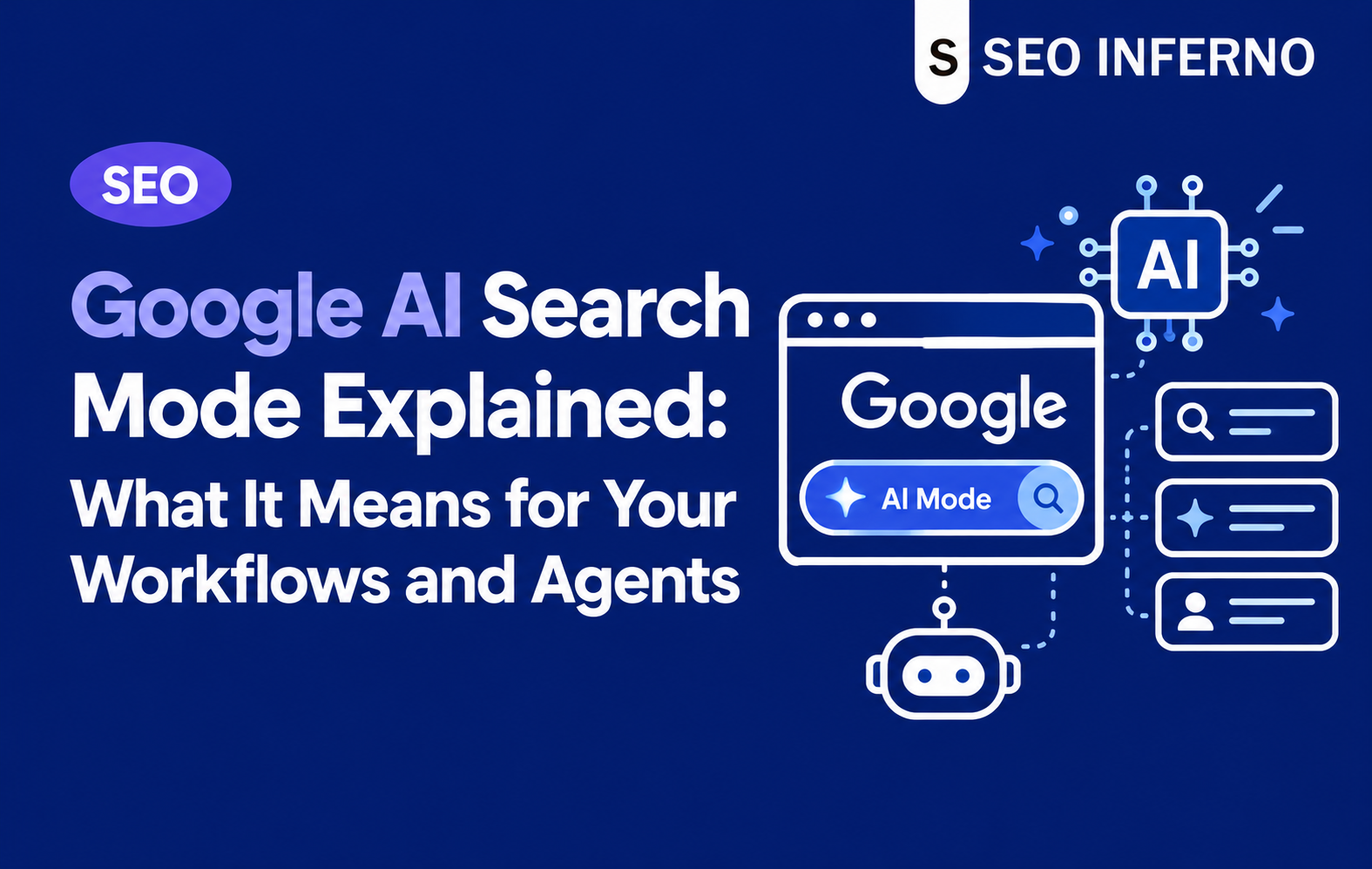
Google AI Mode is no longer an experimental feature and now plays a major role in Search. Google announced in May 2026 at Google I/O that AI Mode has now been used by one billion people each month and that Google has switched to using the Gemini 3.5 model as the default model for all regions of the world. The announcement also announced the addition of information agents, the enhancement of agentic booking, and tools that enable Search to create dashboards and small apps. These changes impact the discovery of content, traffic measurement, and the organization of regular marketing tasks.
What Google AI Mode Is
AI Mode is a new feature in Google Search that is designed to be a conversational experience. It doesn’t just return a ranked list of links, but understands multi-part questions, performs multiple related searches, and constructs a synthesized answer with citations. Input may be text, images, files, video, and browser tabs, and subsequent questions are asked in the same session, preserving context. Google has described the accompanying redesign as the largest change to the search box in more than 25 years.
AI Mode is different from AI Overviews, the shorter summaries shown above the traditional results. It has a more powerful model, can handle longer conversations, and has agentic features that Overviews don’t.
From Answering Questions to Completing Tasks
The biggest change is that Search is no longer just getting started, it’s finishing tasks. These three capabilities stand out:
- Information agents watch a topic in the background and notify users when changes occur, thereby eliminating the need for multiple manual searches. AI Mode monitoring is rolling out to all users worldwide following a paid-only launch, according to Google Search VP Robby Stein.
- Agentic transactions enable users to make restaurant reservations, event tickets and appointments within Search. Google is also rolling out more local services bookings, with some categories in the US allowing Google to make the call for the user.
- Built on Google’s Antigravity technology, generative interfaces enable Search to build custom dashboards and mini apps for ongoing tasks with live data.
Personal Intelligence integration with Gmail and Google Photos is also rolling out, which means answers can be based on the user’s context. A transaction that is carried out within Search relies on integration with Google’s partner systems. A business not in those integrations might not be visible in the booking path.
SEO vs SEM in the AI Mode Era
While the distinction between seo and sem is still relevant, it’s becoming increasingly blurred. SEO is organic traffic, SEM is typically paid search traffic. In AI Mode, the visibility of organic links is becoming more and more important to be cited in a generated response and not among ten blue links. Paid visibility is also evolving, as a conversation takes the place of the traditional results page, and the way paid placements look in those formats continues to evolve.
Since the introduction of I/O, industry reports have suggested that AI-generated responses are driving down some categories’ click-through to publisher sites. This makes it harder to attribute and justifies the consideration of evaluating SEO and SEM budgets together instead of separately. Each of these tools, whether it’s Search Console, analytics or manual citation checks, provide a piece of the picture, but none provides the whole picture.
Why SEO Backlinks Still Matter
AI Mode uses Google’s index, and Google has said that their basic SEO advice applies to AI features. So, authority signals are still relevant. Topically relevant, reputable sites that continue to link to pages with the same topic continue to signal trust, rank pages well enough to be considered sources, and strengthen the search systems’ perception of a brand as an entity.
It’s not about the quantity, it’s about the quality. A handful of editorial links from trusted sites in the same niche is more valuable than a ton of mediocre links, and can also pose a risk in terms of Google’s spam policies. The typical ways to get these links are still the same: digital PR, guest posts, and industry partnerships.
AI SEO Services and SEO Services for AI Search
Two closely related concepts are usually combined. AI SEO services leverage AI to carry out SEO tasks like keyword clustering, identifying content gaps, summarizing technical audit results, and competitor monitoring. The second concept, which is frequently looked for as SEO Services AI, is optimizing a website for AI-generated outcomes such as AI Mode, which is frequently described as answer engine optimization (AEO).
The first idea is well suited to agent-based workflows. An agent can review rankings on a daily basis, mark new competitor content, or create a weekly citation report. Human editing is still required for strategy, fact checking and link outreach, as inaccuracies in the automated output can quickly proliferate when published on a large scale.
The Gemini API provides a foundation for teams developing their own agents, grounding them in Google Search, thereby enabling agents to access real-time web data, rather than relying on a static knowledge cutoff. Clear, up-to-date, and well-sourced content is more useful to humans and machines.
Practical Steps for Teams
- Verify crawlability, structured data, and page speed.
- Create answer ready content, using clear headings, concise definitions and original data.
- Keep earning relevant backlinks from authoritative sites.
- Monitor AI citations in addition to traditional rankings.
- Examine paid and organic budgets side by side.
- Install human checkpoints at all agent workflows.
Conclusion
Google AI Mode transforms Search into a space for questions to be answered, tracked, and acted upon. The basics of SEO remain the same, but now you need to be cited, trusted, and linked to the systems that get things done. Companies that have a solid technical base, have a solid backlink profile and carefully managed automation, will be better equipped for that environment. Businesses looking for AI SEO services or SEO services for AI search can request a free audit from SEO Inferno.